
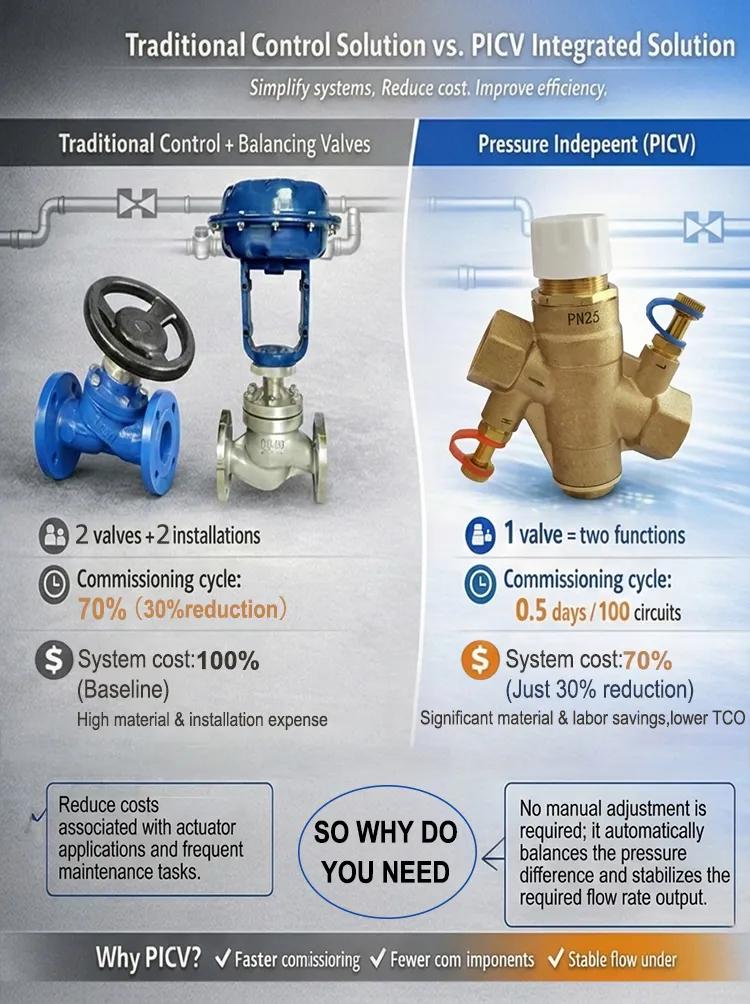
In modern chilled-water HVAC systems, PICV (Pressure Independent Control Valve) offers better control and system stability than a conventional 2-way motorized control valve.
Conventional 2-Way Motorized Valve
- Flow depends on system differential pressure.
- Flow can change when other valves open or close.
- May cause over-flow at low-load conditions.
- Requires proper system balancing.
- Control performance can deteriorate when system pressure fluctuates.
PICV – Pressure Independent Control Valve
- Maintains the required design flow despite differential-pressure changes.
- Combines control valve + differential pressure regulator + flow limiter in one valve.
- Provides accurate flow control at the AHU/FCU.
- Reduces the risk of over-flow and hunting.
- Improves chilled-water ΔT and system efficiency.
- Simplifies hydronic balancing and commissioning.
- Works very well with variable-flow chilled-water systems and VFD pumps.
Why PICV?
2-Way Valve:
Differential pressure changes → Flow changes → Control becomes unstable → Possible low ΔT & wasted pumping energy.
PICV:
Differential pressure changes → PICV regulates → Design flow is maintained → Better temperature control & system efficiency.
🚀 Engineering Advantage
Using PICVs can provide better hydronic balancing, more stable AHU/FCU control, improved ΔT performance, and easier commissioning when properly selected and applied.
PICV = Precise Control + Automatic Flow Regulation + Better System Performance
PICV vs. Conventional 2-Way Motorized Valve
| Parameter | PICV | 2-Way Motorized Valve |
|---|---|---|
| Full Name | Pressure Independent Control Valve | 2-Way Motorized Control Valve |
| Flow Control | Maintains required flow despite pressure variations | Flow changes with system differential pressure |
| Pressure Dependency | Independent of pressure variation within operating range | Pressure dependent |
| Balancing Valve | Usually not required separately | Usually requires separate balancing/balancing control |
| Differential Pressure | Controls/limits ΔP across control section | Does not independently regulate ΔP |
| Design Flow Setting | Can be preset | Normally requires system balancing |
| Valve Authority | High and stable | Can vary significantly |
| Part-Load Performance | Excellent | Depends heavily on system design |
| System Balancing | Easier | More difficult |
| Commissioning | Faster | More time-consuming |
| Over-Flow Risk | Low when correctly selected/set | Higher during low-load/pressure changes |
| Under-Flow Risk | Lower | Possible when system pressure changes |
| Pump Energy | Can reduce unnecessary flow and improve control | May require higher pump pressure/flow margin |
| Control Stability | Excellent | Can become unstable with changing ΔP |
| Suitable for Variable Flow System | Excellent | Good, but requires proper design |
| Installation Cost | Higher | Lower |
| Additional Components | Fewer balancing components may be needed | Balancing valve/DP control may be needed |
| Maintenance | Moderate | Generally simple |
| Best Application | Modern variable-flow HVAC systems | Simple/constant-pressure or smaller systems |
Related Posts
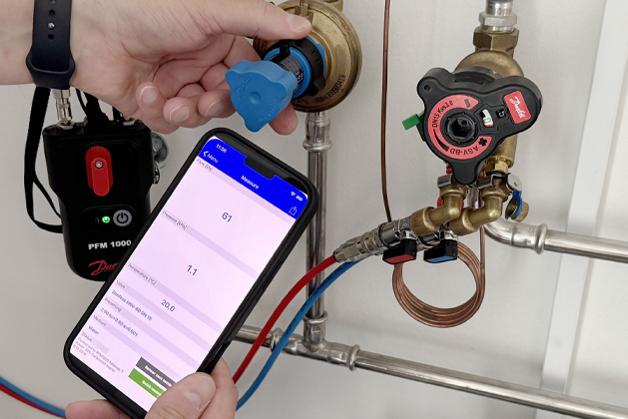
PICV valve comissioning Process Step by step.
Yes. PICV commissioning is mainly about setting the design flow,…
